вторник, 17 июня 2014 г.

Lidiya Skoblikova

(1939- )

Biography

Lidiya Skoblikova is a legendary Soviet athlete, the only 6-time Olympic champion in the history of skating, multiple world champion and record holder.
Lidiya was born in Zlatoust in a large worker family. Since childhood, her favorite hobby was sport . She was engaged in athletics and volleyball , skiing and gymnastics. When Lydiya was 16, she decided to try speed skating, and a year later won the Zlatoust championship, the same year Scoblikova entered the CSPU. In January, 1957 Lydiya won the national championship in speed scating among girls. The first international success came in the 1959 when Skoblikova took the 3rd place at the World Cup in Sverdlovsk. A year later, Lydiya showed the 3rd result at the World Championship in Sweden. In  1960 Skoblikova debuted at the Olympics in Squaw Valley , USA and  won two gold medals. The next Olympics in Innsbruck , Austria became the absolute triumph of the young Soviete athlete. On this Olympics Lidiya seemed to do the impossible - she won all four golden medals in skating competitions. Thus, Skoblikova became the only 6-time Olympic champion in speed skating. The world press unanimously called the Olympics in Innsbruck “The Olympics of Skoblikova”. After the World Cup- 1964 , where Lydiya repeated the Olympic record, again taking the upper hand in all four disciplines, Skoblikova made a decision to finish her sports career and became engaged in coaching and teaching.

Международная известность

Lydiya Skoblikova is rightly considered a legend of Soviet and world sports. In 1960, before the Olympics in Squaw Valley foreign press treated her as one of the best stayers of speed skating. However, some journalists predicted the "Ural lightning" failure on the Olympics, stating the fact that Lydiya flew to the United States having the plane seat number 13 and stayed in a hotel room number 13.
Lidiya Skoblikova 1967.jpgThe Olympics in Squaw Valley were the first Olympics that included competitions in speed skating among women, that's why Skoblikova and other women athletes were viewed with prejudice. Skating requires speed, strength and endurance- qualities that are not developed or absent in females. In one of her interviews during the Olympics Skoblikova  objected the correspondent of Sports Illustrated: "Skating makes us more feminine…. Cycling or skiing takes a lot of muscle, but skating does you no harm."  Skoblikova's appearance and personality often disarmed critics. She was a Russian real beauty with a smile, blue eyes and open face. After winning the race she always went to the stands , waving to spectators , smiling broadly . "At the theater you applaud a good actor who gives you pleasure. When I have won a race, giving people pleasure, I like to skate around the stadium wearing the laurel wreath of victory. People applaud and that gives me pleasure."
4 years later in Innsbruck , Austria Skoblikova created a furore , winning all the gold medals possible in speed skating. Before the Olympics, at a press conference on the question of foreign journalists how many medals she planned to get in Innsbruck , Lydiya answered , " As many as my rivals allow me to get ." "This attractive girl with an iron will is , perhaps, the best female skater ever"- wrote the American magazine " Sports illustrated "after the triumph of the Soviet athlete .
Л.Скобликова
участвует в эстафете
олимпийского огня
Сочи-2014
Experts and correspondents of foreign newspapers and magazines , commenting  Lydiya Skoblikova's skating in Innsbruck , noted the high technique of her run, "absolute harmony of the movements ," and especially admired her will to win , tenacity and strength of her character .
In spite of the fact she finished her sports career in the mid-1960s, Skoblikova did much for the development of sports in the Soviet Union and the creation of a positive image of Soviet athletes abroad.
In 1983, the President of the International Olympic Committee Juan Antonio Samaranch awarded "ice queen" the silver sign of the Olympic Order "For contribution to the promotion of the sports  ideals and outstanding sports achievements."
Nathan Aaseng in the book Women Olympic Champions wrote about Skoblikova: "First, she was a key member of a Soviet national women's team that pushed the limits of achievement far beyond those of the previous generation.… The Russians' success in turn pushed East Germany, the United States, and other countries into developing female athletes.… Second, Skoblikova stood out as an important contradiction to the stereotype of Soviet female athletes as cold, masculine machines. Her combination of incredible strength and endurance, grace under pressure, willingness to let her emotions show, and pride in her appearance, reinforced the idea that women could be warm and feminine and still enjoy and excel in sports."

Learn more:

Photoblog:


Magnitogorsk iron and steel works

About the company

Magnitogorsk Iron and Steel Works ( MMK ) is the largest metallurgical enterprise in Russia. The works carries iron and steel , blast furnace, ore-dressing, coke-chemical and rolling production. The MMK group consists of 87 plants and companies involved into the production and sale of MMK products in Russia and abroad.
The works engineering started in 1925 in Sverdlovsk, and 3 years later, the project was complete and approved by Uralgipromez. Finally, in spring, 1929 the plant construction started. The construction workers from different regions of the country gathered to participate in the main all-union construction project. As a result, the works was built in record time. MMK was oficially commissioned on February 1, 1932 , that day the works produced its first cast. The following year the plant started making steel products, and in 1934 MMK launched the first rolling mill station.
ММК в 1930-х годах
During the Great Patriotic War MMK produced armor metal for the needs of the
Soviet Army. For the purpose the works regularly increased production volumes, as well as put new units into operation. This tendency preserved in the postwar period. In 1950-1960 MMK productivity significantly increased the productivity of the US Ironworks. In the mid-1970s the works reached the production volume of 15 million tons of steel per year, and in 1989 held a record volume in its entire history -16 million tons of steel. In 1990s the production volume decreased due to lower demand for the metal in the country. However , the factory gradually started to implement re-equipment .
In the 21st century MMK increases production capacities, puts into operation new metallurgical facilities, implements the enterprise retooling. As a result, annual metal production has a steady growth. The most ambitious and costly projects of MMK became the recent construction and launch of Rolling Mill 5000 and Rolling mill 2000. Currently MMK is one of the largest steel companies in the world with a long-term program of modernization and strong local and international bonds.

International contacts

For the works construction, along with the Soviet Union workers  the authorities actively invited foreign specialists, mainly from the U.S. MMK project employed about 800 foreign specialists. Steel companies from Europe and the United States took an active part in the MMK construction . The central power plant was built by the German company AEG, refractory production was  made by German Krupp & Reismann, mining production-by British Traylor. In addition, one of the rolling mills for the enterprise was produced by the German company SMS Demag, which still cooperates with MMK on the delivery of metallurgical equipment.
In the postwar period MMK production was mainly realised in the country, but a certain production volume still was exported to the countries of the socialist camp. However, in 1990 the situation changed greatly. The decline in demand for the metal in Russia led to the company's management decision to expand exports. As a result, in 1990s, the export volume in MMK reached 70% of total output.
MMK traditional export geography includes Eastern Europe, Middle East and Southeast Asia. However, in the 21 century exports annually reduce due to the stable growth of the Russian economy, and the management strategy to increase sales of MMK steel on Russian and CIS markets.
один из цехов завода
 MMK- Metallurji (Турция)
Recently MMK actively invests in joint projects with foreign companies and acquires shares of foreign steel companies. One of the major foreign projects of MMK was the construction and commission of a metallurgical plant in Turkey in 2011. The joint venture of MMK and Turkish company Atakas "MMK Metalurji" is situated in Iskenderun (Turkey), the investments to the project totaled $ 2.1 billion. The delivery of equipment for the new plant was organized by an Italian company Danieli, a longtime partner of MMK.
MMK actively develops international export bonds,implements a number of ambitious projects in Russia and abroad, and plays a key role in the global steel market. 

Learn more:

Photoblog:
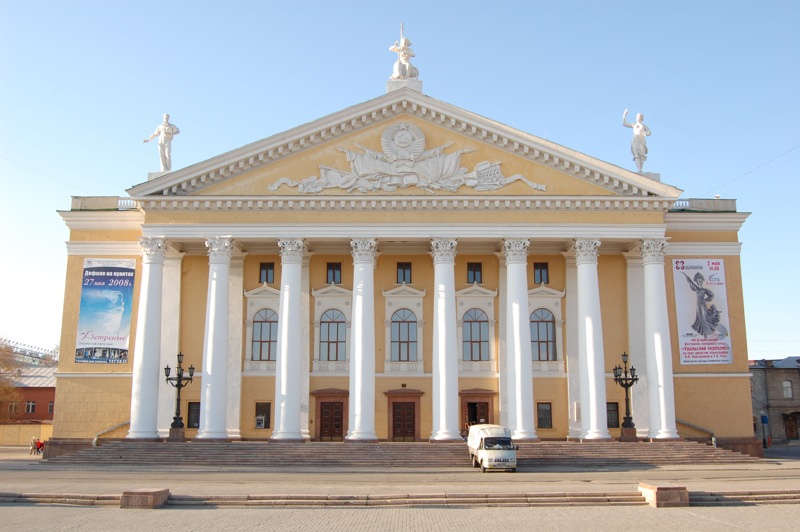
The Chelyabinsk opera and ballet theatre

History

Construction of the Chelyabinsk opera and ballet theatre started in 1937 on the site of the Nativity church, demolished in 1932. The opening date was fixed  for November 7, 1941, but due to the outbreak of World War II it was postponed. During the war, it was decided to place in the building the factory "Calibre" evacuated from Moscow. Only in 1948 when the factory moved out of the theater, the builders started the long-term reconstruction. The theatre was officially opened on September 29, 1956. In 1980-1983 the building was restored , after the restoration the theater gained its present shape .
Currently the Chelyabinsk State Academic Opera and Ballet Theatre is the hallmark of the city. Citizens and guests of the city attend theatrical performances, which become an important and integral part of the cultural life of the region and the country.

International fame

The first international tour of Chelyabinsk Opera and Ballet Theatre held in 2001, when the ballet company and orchestra visited Taiwan. In Taiwan they showed the first night of the ballet "Cinderella ." The ballet-dancers also presented to the audience another ballet - "Swan Lake" and the orchestra performed 3 programs of symphonic music of Russian composers. The tour was held in 12 cities, the company gave 10  ballet performances and 6 symphony concerts .
In 2003 Chelyabinsk Theatre went on tour in the UK. In London, the company presented ballets "Swan Lake" and "the Sleeping Beauty".
The next significant tour took place in 2005. At that time Chelyabinsk company returned from the USA, where it gave more than 60 performances at concert halls in Atlanta. Especially for the tour the company prepared a new concert program, which together with the recognized masterpieces of the Russian ballet produced a great impression on the American public.
In December - January 2009 Chelyabinsk ballet company went to China. The tour started in southern Shenchzhen, where Chelyabinsk presented the ballet " Swan Lake" , and continued on the main Shanghai's stage- in Shanghai Grand Theatre. The performers danced "Swan Lake" and "The Nutcracker", the audience burst into applause. Thunderous ovation was received by prima ballerina Tatiana Predeina and premier dancer Alexei Safronov. Chelyabinsk company also performed  in Northern Dalian and southwestern Kunming, and then returned to Shanghai, where they held the last show of the tour. That performance finally took the Chinese audience by storm.
In September and October 2012 Chelyabinsk Opera and Ballet Theatre took
Опера "Кармен"
part in the International Festival of Dance and Music in Thailand. The company presented 2 operas in Bangkok: Madam Butterfly and Carmen. Queen of Thailand was present at Chelyabinsk performance and praised the skills of Chelyabinsk company. In addition, the orchestra took part in the music record for the last film in the BBC serial "Planet Earth".
From November to December 2012 Chelyabinsk ballet-dancers and orchestra toured in Germany. Chelyabinsk ballet opened the tour with the ballet "Nutcracker" in Dessau. For 1,5 months the company visited 35 cities in Germany , including Berlin, Munich, Leipzig and Frankfurt. The performances were almost daily, sometimes the company gave two performances a day.
Chelyabinsk State Academic Opera and Ballet Theatre of Glinka continues to go on tours and  holds high professional standards performing at various Russian and world stages. Thanks to the talent and skills of the company, the performances and concerts are always a success with the audience , both in Russia and abroad.

Learn more:
http://www.nakanune.ru/news/2004/2/24/cheljabinskijj_teatr_opery_i_baleta
http://lentachel.ru/articles/18314
http://mediazavod.ru/articles/81182
http://www.mediazavod.ru/articles/4516
http://mediazavod.ru/articles/128130

Photoblog:
http://www.belcanto.ru/chelyabinsk.html
http://afisha.yandex.ru/chl/events/403219/

Fortum

About the company

Fortum is a Finnish energy company, which focuses on the production and distribution of electricity,heat and power. The head of the company is Tapio Kuula. The company sets up and operates power plants, and provides other energy and heat related services. Fortum's main market areas are the Nordic and Baltic countries, Russia and Poland.
Fortum was founded in 1998. The new energy group was established by combining the businesses of state owned Imatran Voima (IVO) and the listed company Neste Oil. IVO (founded in 1932) built and operated a number of hydroelectric, coal-fired and nuclear power plants in Finland. Neste Oil focused on the refining and transportation of petroleum products. In 2005 The Neste assets were transferred into a separate stock-listed company. Nowadays Fortum fully or partially holds more than 500 energy enterprises in different countries with 10800 employees. It is currently the only Nordic energy company registered on the Dow Jones Sustainability Index (DJSI).

The company in Chelyabinsk and the Chelyabinsk region


Челябинская ТЭЦ-3
In 2004 Fortum owned 30 % of the share capital of Russian energy company Lenenergo and automatically came into the Russian energy market. In 2008 Fortum bought controlling interest in the Russian Territorial Company 10 (TGC-10) through a share auction conducted as part of the Russian power sector reform. In 2009 the company was renamed into OAO Fortum. The headquarters is situated in Chelyabinsk. Currently OAO Fortum is one of the leading energy companies in the Urals and the Western Siberia .It comprises 9 power plants, 5 of them are in the Chelyabinsk region. According to the launched investment program Fortum set up the scale development and modernization of the Chelyabinsk energy industries.
In 2009 Fortum started gradual capital improvement authorization of the equipment at the Chelyabinsk state district power plant in order to increase the reliability and efficiency of its operation. In 2010 Fortum set up an ambitious investment project “Ring”, which is aimed at the integration of Chelyabinsk’s district heating system into the technological ring around the city. The main goal of the project is to make the connection between CPH-3, the state district power plant and  the north-west boiler station. Gradually this measure will lead to 30%  cutdown in power spending and the absence of hot water outage. The project is to be finished in 2016.
In 2011 Fortum commissioned a new on-shore pumping station equipment at CPH-1. The station provides water consumption not only for the power plant but for a number of city plants. Besides, the company carried out capital investment of monitoring and control systems of CPH-1 and started the range of works on including CPH-1 into the ring scheme of the city’s heat supply system.
On June 7, 2011 Fortum commissioned a new power plant unit on CPH-3 and started the works on building the 7,5 km heat transport system between CPH-3 and district power station, the key element of the Ring project.
In 2012 Fortum started the construction of 2 gas turbines at the Chelyabinsk state district power station. The project completion date is 2014. Besides, the company set up the range of works on modernization of equipment (turbo generators) on CPH-2.
In summer 2013 Fortum  transite pipeline between CPH-1 and CPH-2.The launch of the new pipeline will increase the amount of customers and the amount of energy produced.
Commenting on the capital improvement programs at Chelyabinsk power plants and the ambitious investment projects of Fortum the governor of the Chelyabinsk region said the following: “I am pleased with the development of our cooperation with Fortum. The building of new capacities causes the energy tax reduction by means of energy performance increase, provides new residential districts with reasonable energy taxes, creates a vast tax basis and employment opportunities for our citizens”.

Learn more:

Photoblog:

Chelyabinsk Tractor Plant

About the company

On May 29, 1929 the Soviet government made a decision to build a Tractor plant in Chelyabinsk. In spring, 1930 the construction project was completed, and 3 years later the factory already produced the first Soviet crawler tractor Stalinets-60. Since 1939 the plant started the production of  military equipment, and in 1940, ChTZ made its first tank.
During the Great Patriotic War  ChTZ and other plants evacuated to Chelyabinsk formed the famous "Tankograd" - the factory for tank production. The enterprise became the first in the world that had assembly line production of tanks.
After the war, ChTZ returned to peaceful production. ChTZ tractors were highly desirable both in the USSR and abroad. Chelyabinsk machines were widely used in various sectors of the Soviet economy , in the construction of the Volga-Don Canal , land clearing and other ambitious projects. In 1984 the plant produced its millionth tractor. In 1992 the company was transformed into ChTZ-Uraltrak, later Uraltrac LLC. In March, 2011 ChTZ joined the Research and Production Corporation Uralvagonzavod. At present Chelyabinsk Tractor plant remains one of the leaders of the domestic engineering, producing new pieces of equipment, and actively selling its products both in Russia and abroad.

International contacts

первый трактор ЧТЗ Сталинец-60 (С-60)
Трактор С-60
In the early 1930s the construction of such a plant as ChTZ in the Soviet Union required not only big money, but also the international experience in the field of engineering. That is why the plant construction project was prepared by the company "Albert Kahn Inc." from Detroit, which previously created the construction projects of Ford and General Motors plants in the United States. For this purpose in Detroit there was organized a special design office " Chelyabinsk Tractor Plent " in which Soviet and American engineers developed the plant project. Besides designing , foreign companies were actively involved in providing ChTZ with modern equipment. Equipment was produced and delivered by the companies from Germany, USA, France and England.
Taking into account the fact that the plant was one of the most modern machine-building enterprises of that time, its products soon gained recognition in the global market. In 1937 tractor S-65 won the "Grand Prix" at the World Exhibition in Paris, in the 1960s ChTZ tractors got gold medals in international technical exhibitions, and in 1988 Tractor T-800 was recorded in the Guinness Book of Records as the world's first super-power tractor.
Exports always took an important part in ChTZ corporate activities. In Soviet times ChTZ products were mainly exported to the countries of the socialist camp. The Chelyabinsk machines  worked worldwide, participating in a variety of tasks and projects. The ChTZ products of the Soviet period are still famous around the world. For example, in the museum of engineering troops in Vietnam there is a tractor T-100,used in the construction of fortifications during the Vietnam war.
In the 1990s, ChTZ exports decreased due to the decline of production volume. However, in the early 2000s, the company began an active policy to restore the previous international bonds and increase exports. The enterprise resumed the supply of products to the countries of the former Soviet Union and Eastern Europe. Moreover, ChTZ managed to come into the markets of Southeast Asia and Africa.
In 2002 ChTZ resumed foreign supplies of cast iron grates, inlets, manholes to Europe. Currently ChTZ products can be seen on the streets of Italy, Spain, Portugal and Finland.
In 2007 exports achieved a quarter of the total production volume of the enterprise. The same year CTZ participated in the International Industrial Exhibition in Hanoi "VIIF-2007", the international trade fair for construction machinery and equipment "Caucas Build" in Tbilisi. Furthermore, the factory made a big contract with a company from Indonesia on the delivery of bulldozers, loaders and   pipe-layers.
Due to the proper export policy, ChTZ was recognized the best Russian exporter in 2006 and 2007. In 2009 ChTZ products got European certificates, and thus was allowed to establish joint ventures with the countries of the European Union. In 2010, together with the Italian foundry partners ChTZ commissioned a mini-factory.
ChTZ has traditional export bonds with companies in the Middle East, Africa, Central and Southeast Asia, including Egypt, Algeria, the United Arab Emirates, India, Vietnam, Cambodia, Mongolia and others. Today ChTZ smoothly increases production capacities, and expands the sales geography, what make the ChTZ products remain competitive at the Russian and international markets.

Learn more:

Photoblog:
http://chtz-uraltrac.ru/
http://www.uralmob.ru/news/259

Jaroslav Hasek 

(1883-1923)

Biography

A famous Czech writer and satirist Jaroslav Hasek was born in 1883 in Prague in the teacher's family. In 1889 he entered an elementary school, then studied at a high school. However, due to financial difficulties of the family associated with the death of his father , Jaroslav had to leave school . At age 14, Hasek took an active part in the anti-German riots, for which he was repeatedly detained by the police. In 1902 Hasek successfully graduated from business school and started working in a bank. However, Hasek was not interested in banking career , and soon after numerous absences got fired. In summer 1903 Jaroslav traveled to Eastern Europe , and several times was arrested by the police for vagrancy.
After return to Prague and the release of the first collection of poems Hasek decided to become a writer. He started writing humorous stories that soon became popular in his motherland. In 1909 Hasek worked as the editor of the magazine " World of Animals" , and after a while even opened Dog Training Institute, where he was engaged in illegal dogs selling and was accused of fraud. Generally , the name of Hasek often figured in the police reports , but he not only knew how to get into various funny situations , but also had a talent to describe all happened to him on paper , in his notes and short stories. That ability quickly turned Jaroslav into a popular Czech satirist.
In 1915 Hasek went off to war, but the same year in the battles near Dubno was captured by the Russian army. After joining the Czechoslovak Legion , he settled in Kiev, and then moved to Moscow, where joined the Communist Party.  As part of the 5th Army of the Eastern Front Hasek participated in political work in the cities from Samara to Irkutsk. In Irkutsk he was even elected a deputy of the city council. In 1920 in order to promote the ideas of communism and the world proletarian revolution Hasek returned to Prague. However, the Check public met him without enthusiasm. As a result , in 1922 he moved to Lipnits , where a year later died from diseases.


Мемориальная доска 
на месте дома в Челябинске,
где работал Я.Гашек
On August 17, 1919 as part of the 5th Army of the Eastern Front Hasek arrived in Chelyabinsk. Hasek spoke the Russian language fluently,what helped him to do the political work in the city successfully. During the time spent in the city, the writer took an active part in the establishment of the local Soviet authorities, headed the army typography, and also worked as the chief of  the international department of the army. Hasek not only published articles in Front newspapers , but also wrote for Chelyabinsk newspaper "Steppe commune" . In addition, he conducted lectures and gave agitational concerts in the Red Army club. In Chelyabinsk Hasek had 12 international meetings and 9 conversations on political issues. As a result of his work 720 foreign prisoners of war volunteered in the Red army and 468 foreigners came to work on local enterprises. On November 14, 1919 , together with the political department of the 5th Army, Hasek left Chelyabinsk.
A street in the Metallurgical district, and a library in Traktorozavodsky district of Chelyabinsk are named after Hasek. The building on the street Timirjazeva, 41d , where Hasek worked, has a memorial plate. 

Learn more:

Photoblog:
Emerson

About the company

The Emerson Electric Company is an American multinational corporation which provides equipment, technology solutions and engineering services for a wide range of industries.  Currently Emerson has 235 enterprises in 150 countries with 127,800 employees what makes Emerson one of the largest equipment manufacturers in the world.
Emerson was established in 1890 in St.Louis , Missuri by John Wesley Emerson and Meson Brs. Originally the company specialized in the manufacture of electric motors and fans. Emerson was the 1st to produce and sell electric fans in the USA. Later Emerson expanded its product line with electric sewing machines, electric dental drills, ceiling fans and power tools. During World War II, Emerson focused military production contracts and became  the world's largest manufacturer of airplane armament. In 1954  under B.W. Person leadership the company started  research and development programs aimed at  making foreign markets .When he retired in 1973, the company had 82 plants, 31,000 employees and $800 million in sales.
Charles F. Knight served as CEO from 1973 to 2000 continued a course for new product and technology development, acquisitions and joint ventures, and international growth.
Structurally Emerson Corporation consists of 9 business platforms that in turn include a wide range of brands and enterprises. All together the platforms form one of 500 world’s largest companies, which develops industry-leading technology, invests globally and creates long-term value for its shareholders, customers, and employees. Emerson’s mission and values are properly expressed in the company’s brand promise:
"Emerson is where technology and engineering come together to create solutions for the benefit of our customers, driven without compromise for a world in action".

Company's business in Chelyabinsk and the Chelyabinsk region

The first deal between Emerson and Russia was made in 1935 when the company produced and delivered valves "Fisher Controls" to one of the Soviet plants.  However, only in 1989 the company obtained accreditation with the right to do business in the USSR. From that time Emerson started developing the Russian market in active way. In 1992 the corporation built up the new subsidiary company "Fisher-Rosemount" which became the major Emerson enterprise doing business in Russia. In 2002 after restructuring the enterprise was renamed into Emerson Process Management (EPM). Emerson started doing business in Chelyabinsk in 1996 when  the industrial group Metran became the official dealer of Emerson products in Russia. In 2004 EPM entered into partnership with Metran and launched the investment program into the Chelyabinsk company, which focused the production of pressure transmitters. In 2005 the company started cooperating with the SUSU on the personnal training of engineers. In 2006 Emerson and Metran commissioned a new laboratory of smart instrumentation in the SUSU- PlantWeb. The same year Metran launched a hardware and software system “Ovatsiya” on CPH-3 and delivered the smart instrumentation to the power plant.In 2007 Metran in partnership with Fisher commissioned the production line of GX valves by Fisher. A year later one of the numerous Metran products won the contest-“20 best products of the Chelyabinsk region”. In 2009 Emerson took over Metran, which became the subsidiary company of EPM. In autumn 2013 Emerson commissioned the new production line of temperature transmitters and a bit earlier launched the building of a new office and production center. The volume of investments into the project is 40 mln $. The new plant will create 1600 work positions. The project is to be finished in 2015.

Learn more: