вторник, 17 июня 2014 г.


Kasli art castings

History

Construction of the  foundry in Kasli started in 1745 . In 1749 the plant was commissioned , and in 1751 was bought by the Demidovs, great Russian industrialists. The Kasli foundry was a relatively small enterprize, with one blast furnace and a factory producing iron. The major part of workers were bondmen, that was an ordinary situation at those times. Initially, the plant produced cast iron and iron, and executed military orders (producing cannons, balls and case-shot )
In 1809 Demidov sold the factory to the merchant L.I.Rastorguev. In the years 1811-1817 due to the Napoleonic Wars the plant specialized at mass production of balls , bombs, grenades and case-shot . After 1817 the foundry started a gradual transition to the production of household items - iron crockery, openwork gates and fences, cabinet goods. The production of art castings was established only at the early 1850s . At that time the masters began the casting of famous horse sculptures  on the models by P.K. Klodt, that was a turning point for the development of animal genre of Kasli art casting.
At the beginnng of 20th century due to increased investment Kasli foundry turned into the main Ironworks of the District, and in 1907 became the part of the English-Kyshtym joint-stock company.  However, management plans to further development were prevented by the First World War and the October Revolution of 1917. Since 1914, the plant began to produce mortar shells for artillery, consequently, the production of art castings was  resumed in the early 1920s. In 1934, at the factory there was commissioned a workshop of art castings. The  foundry also started producing large-size castings for bridges and parks of the cities of the USSR . Currently Kasli foundry produces a  great variety of high quality architectural and art castings. The products of the plant are treated as a recognized Russian brand.

International fame

In the second half of the 18th century, the products of Kasli foundry was actively exported to Europe, mainly to England, where at that time there was a crisis of metallurgy. However, with the transition of European plants to the more advanced production technologies , the export of Russian metal to Europe stopped. Over half a century the plant products were not exported from Russia. Only in the 1860s Kasli art casting appeared at the international exhibitions.
Kasli art casting became well-known abroad. In 1867 the plant products won a silver medal at the World exhibition in Paris. The awards of Kasli castings include a big gold medal at an exhibition in Vienna (1873 ) , a bronze medal at the exhibition in Philadelphia (1876 ) , an honorary diploma of the exhibition in Copenhagen (1888) , a bronze medal at the World Exhibition in Chicago (1893) , a gold medal at the international exhibition in Stockholm (1897).
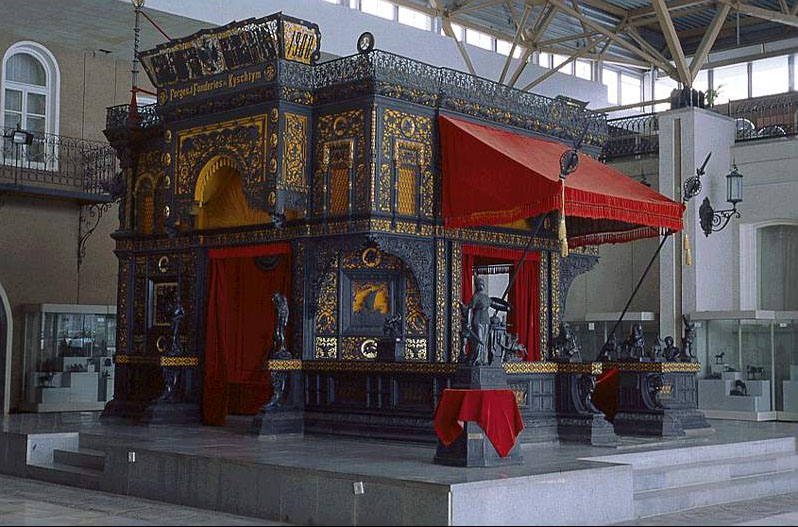
Каслинский чугунный павильон
In 1900 Kasli iron and art castings took the Grand Prix at the World Art and Industry Exhibition in Paris. Specially for this exhibition Kasli masters created a huge cast iron pavilion-palace in the Byzantine style on the project by E.Baumgarten. The pavilion literally struck jury and visitors of the exhibition. Entrance to the palace was decorated with sculpture “Russia” by N.Laveretskiy. After the exhibition , several visitors offered to purchase pavilion with all exhibits, including the sculpture " Russia ." However, Russian flatly refused to sell abroad this sculpture because it demonstrated a symbolism of Russian power. As a result, the pavilion returned to its homeland . At the moment Cast iron palace is found in the Museum of Fine Arts (Yekaterinburg) . The Pavilion is included in UNESCO catalog as the world's only architectural structure of cast iron, located in the museum's collection .
The unprecedented success of the Ural masters in Paris attracted foreign investors to the plant. Casting production from Kasli interested Englishmen . In 1906 Kasli products received a gold medal at the exhibition in Milan , and a year later the plant became a part of the English- Kyshtym corporation. British engineer Leslie Urquhart was appointed to the post of Director. The plant gradually increased its capacity through the employment increase, as well as modernization of production base and production technologies.
After the events of 1917 Anglo-Kyshtym corporation was abolished, and the production of artistic castings resumed only in the early 1920s. Today Kasli products are in great requisition among Russian consumers, they are regularly demonstrated at the Russian exhibitions. One of the last major orders was the production of 500 lampposts that were installed on one of the quays of Sochi, the capital of the Winter Olympics-2014.

Learn more:
http://ru.wikipedia.org/wiki/%D0%9A%D0%B0%D1%81%D0%BB%D0%B8
http://kasly.su/History_Kasly_08.htm
http://kasly.su/History_Kasly_04.htm


Kusa art castings

History

The history of Ironworks in Kusa began in 1754 , when the founders of the plant the Mosolovs brothers purchased the land for the works construction. In 1778, the Kusa Ironworks was commissioned.Originally, the plant produced nails, staples and hoops, in the mid-19th century craftsmen also made houseware , heating and architectural molding.

International fame

The first samples of the Kusa art castings were dated 1883 . The decorated goods of the Kusa masters differed from the Kasli art castings in the appearance and the cast quality. More than 400 samples of the Kusa art castings were demonstrated at the international exhibitions. Decorated goods from Kusa won  top prizes at the exhibitions in Copenhagen (1888 ), Stockholm ( 1897) , Glasgow ( 1901) , Milan (1906), Malta (1914). The highest triumph of the Kusa castings became the Grand Prix at the exhibition in Milan (1906). The plant's products continued to be actively exhibited in the Soviet times. In particular, the production of the Ironworks was awarded a gold medal at the exhibition in Bulgaria ( 1988). In 1994 Kusa castings were presented at the exhibition in Paris. However, in spite of the international success after the Great Patriotic War the plant reduced the volume of art castings  produced. Currently, the Kusa machine engineering plant continues producing the Kusa art castings.

Learn more:
http://allday2.com/index.php?newsid=173177
http://ru.wikipedia.org/wiki/%D0%9A%D1%83%D1%81%D0%B8%D0%BD%D1%81%D0%BA%D0%B8%D0%B9_%D0%BB%D0%B8%D1%82%D0%B5%D0%B9%D0%BD%D0%BE-%D0%BC%D0%B0%D1%88%D0%B8%D0%BD%D0%BE%D1%81%D1%82%D1%80%D0%BE%D0%B8%D1%82%D0%B5%D0%BB%D1%8C%D0%BD%D1%8B%D0%B9_%D0%B7%D0%B0%D0%B2%D0%BE%D0%B4
http://www.klmz74.ru/about_plant_02.php


Evgeni Malkin

(1986- )


Biography

The star of NHL and the Russian ice hockey team Evgeni Malkin was born in 1986 in Magnitogorsk. Malkin started skating at the age of 3, and a few years later began to play hockey in the hockey school of Metallurg Magnitogorsk. Initially, Malkin did not differentiate himself from hockey players of his age , and at 15 he even did not get into the hockey team of the Ural region. Nevertheless, his talent and dedication proved that Malkin deserved to play hockey at the highest level. In 2004, Malkin got into the junior national team of Russia and  the same year won the Junior World Championship in Minsk. Evgeni's successes did not go unnoticed, forward joined  Russian youth national team. As part of the team Malkin won two  silver medals at the world championships.
In 2003 Malkin played his first match for the first team of Metallurg Magnitogorsk, and in 2005-2006 season won the "Golden Slam"- the prize to the best center forward of the championship. 

International fame

In 2006, during the off-season tournament for the Cup of Tampere Malkin suddenly left  the Metallurg team and went to the NHL where signed a contract with the club "Pittsburgh Penguins". However, at the same time Malkin had   a valid contract with Metallurg, that's why after the complaints of the club from Magnitogorsk, the Russian Ice Hockey Federation prohibited Malkin to play for any club until eliminating all trials. Nevertheless, the court of the New York State rejected the claim of Metallurg and on September 20, 2006 Malkin played his first match for Pittsburgh.
In the NHL Malkin continued his successful sports career. In the 2008-2009 season as part of the Penguins Malkin won the Stanley Cup and the Conn Smythe Trophy (prize to the best player of the season in the NHL). Playing in the NHL  Malkin became the best scorer of the league in 2009 and 2012, and won a series of  other personal trophies.
In 2012, as part of the Russian national team Malkin became the World Champion, and  got the prize to the most valuable player of the championship. A year later due to the NHL lockout Malkin returned to Metallurg. He played 37 matches for the club and scored 65 points. On his return to NHL the hockey player signed a new 8-year contract with the Penguins.
Malkin does not forget about his hometown and the team in which he became a top player. After getting the Stanley Cup Malkin brought it to Magnitogorsk, where everyone had the opportunity to take photos with Malkin and trophy on the main square in front of MMK. Currently Evgeni Malkin is one of the most talented and highly paid hockey players of the world, the star of Russian and international Ice hockey. 

Learn more:

Photoblog:

Lidiya Skoblikova

(1939- )

Biography

Lidiya Skoblikova is a legendary Soviet athlete, the only 6-time Olympic champion in the history of skating, multiple world champion and record holder.
Lidiya was born in Zlatoust in a large worker family. Since childhood, her favorite hobby was sport . She was engaged in athletics and volleyball , skiing and gymnastics. When Lydiya was 16, she decided to try speed skating, and a year later won the Zlatoust championship, the same year Scoblikova entered the CSPU. In January, 1957 Lydiya won the national championship in speed scating among girls. The first international success came in the 1959 when Skoblikova took the 3rd place at the World Cup in Sverdlovsk. A year later, Lydiya showed the 3rd result at the World Championship in Sweden. In  1960 Skoblikova debuted at the Olympics in Squaw Valley , USA and  won two gold medals. The next Olympics in Innsbruck , Austria became the absolute triumph of the young Soviete athlete. On this Olympics Lidiya seemed to do the impossible - she won all four golden medals in skating competitions. Thus, Skoblikova became the only 6-time Olympic champion in speed skating. The world press unanimously called the Olympics in Innsbruck “The Olympics of Skoblikova”. After the World Cup- 1964 , where Lydiya repeated the Olympic record, again taking the upper hand in all four disciplines, Skoblikova made a decision to finish her sports career and became engaged in coaching and teaching.

Международная известность

Lydiya Skoblikova is rightly considered a legend of Soviet and world sports. In 1960, before the Olympics in Squaw Valley foreign press treated her as one of the best stayers of speed skating. However, some journalists predicted the "Ural lightning" failure on the Olympics, stating the fact that Lydiya flew to the United States having the plane seat number 13 and stayed in a hotel room number 13.
Lidiya Skoblikova 1967.jpgThe Olympics in Squaw Valley were the first Olympics that included competitions in speed skating among women, that's why Skoblikova and other women athletes were viewed with prejudice. Skating requires speed, strength and endurance- qualities that are not developed or absent in females. In one of her interviews during the Olympics Skoblikova  objected the correspondent of Sports Illustrated: "Skating makes us more feminine…. Cycling or skiing takes a lot of muscle, but skating does you no harm."  Skoblikova's appearance and personality often disarmed critics. She was a Russian real beauty with a smile, blue eyes and open face. After winning the race she always went to the stands , waving to spectators , smiling broadly . "At the theater you applaud a good actor who gives you pleasure. When I have won a race, giving people pleasure, I like to skate around the stadium wearing the laurel wreath of victory. People applaud and that gives me pleasure."
4 years later in Innsbruck , Austria Skoblikova created a furore , winning all the gold medals possible in speed skating. Before the Olympics, at a press conference on the question of foreign journalists how many medals she planned to get in Innsbruck , Lydiya answered , " As many as my rivals allow me to get ." "This attractive girl with an iron will is , perhaps, the best female skater ever"- wrote the American magazine " Sports illustrated "after the triumph of the Soviet athlete .
Л.Скобликова
участвует в эстафете
олимпийского огня
Сочи-2014
Experts and correspondents of foreign newspapers and magazines , commenting  Lydiya Skoblikova's skating in Innsbruck , noted the high technique of her run, "absolute harmony of the movements ," and especially admired her will to win , tenacity and strength of her character .
In spite of the fact she finished her sports career in the mid-1960s, Skoblikova did much for the development of sports in the Soviet Union and the creation of a positive image of Soviet athletes abroad.
In 1983, the President of the International Olympic Committee Juan Antonio Samaranch awarded "ice queen" the silver sign of the Olympic Order "For contribution to the promotion of the sports  ideals and outstanding sports achievements."
Nathan Aaseng in the book Women Olympic Champions wrote about Skoblikova: "First, she was a key member of a Soviet national women's team that pushed the limits of achievement far beyond those of the previous generation.… The Russians' success in turn pushed East Germany, the United States, and other countries into developing female athletes.… Second, Skoblikova stood out as an important contradiction to the stereotype of Soviet female athletes as cold, masculine machines. Her combination of incredible strength and endurance, grace under pressure, willingness to let her emotions show, and pride in her appearance, reinforced the idea that women could be warm and feminine and still enjoy and excel in sports."

Learn more:

Photoblog:


Magnitogorsk iron and steel works

About the company

Magnitogorsk Iron and Steel Works ( MMK ) is the largest metallurgical enterprise in Russia. The works carries iron and steel , blast furnace, ore-dressing, coke-chemical and rolling production. The MMK group consists of 87 plants and companies involved into the production and sale of MMK products in Russia and abroad.
The works engineering started in 1925 in Sverdlovsk, and 3 years later, the project was complete and approved by Uralgipromez. Finally, in spring, 1929 the plant construction started. The construction workers from different regions of the country gathered to participate in the main all-union construction project. As a result, the works was built in record time. MMK was oficially commissioned on February 1, 1932 , that day the works produced its first cast. The following year the plant started making steel products, and in 1934 MMK launched the first rolling mill station.
ММК в 1930-х годах
During the Great Patriotic War MMK produced armor metal for the needs of the
Soviet Army. For the purpose the works regularly increased production volumes, as well as put new units into operation. This tendency preserved in the postwar period. In 1950-1960 MMK productivity significantly increased the productivity of the US Ironworks. In the mid-1970s the works reached the production volume of 15 million tons of steel per year, and in 1989 held a record volume in its entire history -16 million tons of steel. In 1990s the production volume decreased due to lower demand for the metal in the country. However , the factory gradually started to implement re-equipment .
In the 21st century MMK increases production capacities, puts into operation new metallurgical facilities, implements the enterprise retooling. As a result, annual metal production has a steady growth. The most ambitious and costly projects of MMK became the recent construction and launch of Rolling Mill 5000 and Rolling mill 2000. Currently MMK is one of the largest steel companies in the world with a long-term program of modernization and strong local and international bonds.

International contacts

For the works construction, along with the Soviet Union workers  the authorities actively invited foreign specialists, mainly from the U.S. MMK project employed about 800 foreign specialists. Steel companies from Europe and the United States took an active part in the MMK construction . The central power plant was built by the German company AEG, refractory production was  made by German Krupp & Reismann, mining production-by British Traylor. In addition, one of the rolling mills for the enterprise was produced by the German company SMS Demag, which still cooperates with MMK on the delivery of metallurgical equipment.
In the postwar period MMK production was mainly realised in the country, but a certain production volume still was exported to the countries of the socialist camp. However, in 1990 the situation changed greatly. The decline in demand for the metal in Russia led to the company's management decision to expand exports. As a result, in 1990s, the export volume in MMK reached 70% of total output.
MMK traditional export geography includes Eastern Europe, Middle East and Southeast Asia. However, in the 21 century exports annually reduce due to the stable growth of the Russian economy, and the management strategy to increase sales of MMK steel on Russian and CIS markets.
один из цехов завода
 MMK- Metallurji (Турция)
Recently MMK actively invests in joint projects with foreign companies and acquires shares of foreign steel companies. One of the major foreign projects of MMK was the construction and commission of a metallurgical plant in Turkey in 2011. The joint venture of MMK and Turkish company Atakas "MMK Metalurji" is situated in Iskenderun (Turkey), the investments to the project totaled $ 2.1 billion. The delivery of equipment for the new plant was organized by an Italian company Danieli, a longtime partner of MMK.
MMK actively develops international export bonds,implements a number of ambitious projects in Russia and abroad, and plays a key role in the global steel market. 

Learn more:

Photoblog:
The Chelyabinsk opera and ballet theatre

History

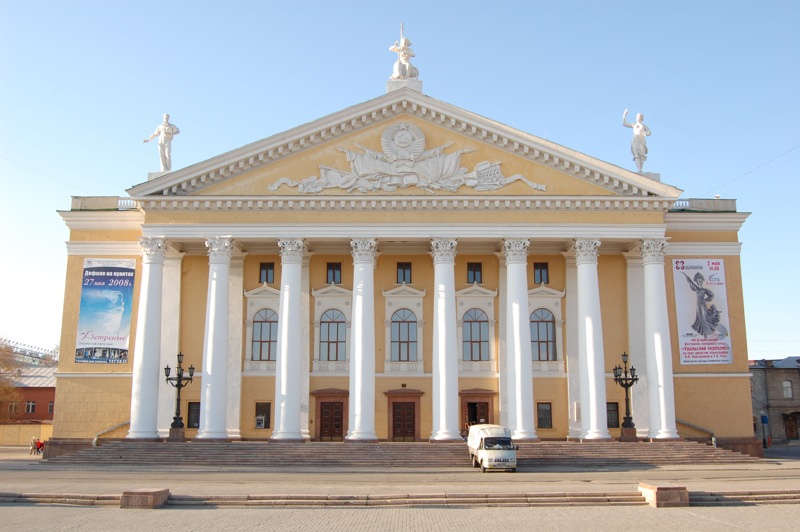
Construction of the Chelyabinsk opera and ballet theatre started in 1937 on the site of the Nativity church, demolished in 1932. The opening date was fixed  for November 7, 1941, but due to the outbreak of World War II it was postponed. During the war, it was decided to place in the building the factory "Calibre" evacuated from Moscow. Only in 1948 when the factory moved out of the theater, the builders started the long-term reconstruction. The theatre was officially opened on September 29, 1956. In 1980-1983 the building was restored , after the restoration the theater gained its present shape .
Currently the Chelyabinsk State Academic Opera and Ballet Theatre is the hallmark of the city. Citizens and guests of the city attend theatrical performances, which become an important and integral part of the cultural life of the region and the country.

International fame

The first international tour of Chelyabinsk Opera and Ballet Theatre held in 2001, when the ballet company and orchestra visited Taiwan. In Taiwan they showed the first night of the ballet "Cinderella ." The ballet-dancers also presented to the audience another ballet - "Swan Lake" and the orchestra performed 3 programs of symphonic music of Russian composers. The tour was held in 12 cities, the company gave 10  ballet performances and 6 symphony concerts .
In 2003 Chelyabinsk Theatre went on tour in the UK. In London, the company presented ballets "Swan Lake" and "the Sleeping Beauty".
The next significant tour took place in 2005. At that time Chelyabinsk company returned from the USA, where it gave more than 60 performances at concert halls in Atlanta. Especially for the tour the company prepared a new concert program, which together with the recognized masterpieces of the Russian ballet produced a great impression on the American public.
In December - January 2009 Chelyabinsk ballet company went to China. The tour started in southern Shenchzhen, where Chelyabinsk presented the ballet " Swan Lake" , and continued on the main Shanghai's stage- in Shanghai Grand Theatre. The performers danced "Swan Lake" and "The Nutcracker", the audience burst into applause. Thunderous ovation was received by prima ballerina Tatiana Predeina and premier dancer Alexei Safronov. Chelyabinsk company also performed  in Northern Dalian and southwestern Kunming, and then returned to Shanghai, where they held the last show of the tour. That performance finally took the Chinese audience by storm.
In September and October 2012 Chelyabinsk Opera and Ballet Theatre took
Опера "Кармен"
part in the International Festival of Dance and Music in Thailand. The company presented 2 operas in Bangkok: Madam Butterfly and Carmen. Queen of Thailand was present at Chelyabinsk performance and praised the skills of Chelyabinsk company. In addition, the orchestra took part in the music record for the last film in the BBC serial "Planet Earth".
From November to December 2012 Chelyabinsk ballet-dancers and orchestra toured in Germany. Chelyabinsk ballet opened the tour with the ballet "Nutcracker" in Dessau. For 1,5 months the company visited 35 cities in Germany , including Berlin, Munich, Leipzig and Frankfurt. The performances were almost daily, sometimes the company gave two performances a day.
Chelyabinsk State Academic Opera and Ballet Theatre of Glinka continues to go on tours and  holds high professional standards performing at various Russian and world stages. Thanks to the talent and skills of the company, the performances and concerts are always a success with the audience , both in Russia and abroad.

Learn more:
http://www.nakanune.ru/news/2004/2/24/cheljabinskijj_teatr_opery_i_baleta
http://lentachel.ru/articles/18314
http://mediazavod.ru/articles/81182
http://www.mediazavod.ru/articles/4516
http://mediazavod.ru/articles/128130

Photoblog:
http://www.belcanto.ru/chelyabinsk.html
http://afisha.yandex.ru/chl/events/403219/

Fortum

About the company

Fortum is a Finnish energy company, which focuses on the production and distribution of electricity,heat and power. The head of the company is Tapio Kuula. The company sets up and operates power plants, and provides other energy and heat related services. Fortum's main market areas are the Nordic and Baltic countries, Russia and Poland.
Fortum was founded in 1998. The new energy group was established by combining the businesses of state owned Imatran Voima (IVO) and the listed company Neste Oil. IVO (founded in 1932) built and operated a number of hydroelectric, coal-fired and nuclear power plants in Finland. Neste Oil focused on the refining and transportation of petroleum products. In 2005 The Neste assets were transferred into a separate stock-listed company. Nowadays Fortum fully or partially holds more than 500 energy enterprises in different countries with 10800 employees. It is currently the only Nordic energy company registered on the Dow Jones Sustainability Index (DJSI).

The company in Chelyabinsk and the Chelyabinsk region


Челябинская ТЭЦ-3
In 2004 Fortum owned 30 % of the share capital of Russian energy company Lenenergo and automatically came into the Russian energy market. In 2008 Fortum bought controlling interest in the Russian Territorial Company 10 (TGC-10) through a share auction conducted as part of the Russian power sector reform. In 2009 the company was renamed into OAO Fortum. The headquarters is situated in Chelyabinsk. Currently OAO Fortum is one of the leading energy companies in the Urals and the Western Siberia .It comprises 9 power plants, 5 of them are in the Chelyabinsk region. According to the launched investment program Fortum set up the scale development and modernization of the Chelyabinsk energy industries.
In 2009 Fortum started gradual capital improvement authorization of the equipment at the Chelyabinsk state district power plant in order to increase the reliability and efficiency of its operation. In 2010 Fortum set up an ambitious investment project “Ring”, which is aimed at the integration of Chelyabinsk’s district heating system into the technological ring around the city. The main goal of the project is to make the connection between CPH-3, the state district power plant and  the north-west boiler station. Gradually this measure will lead to 30%  cutdown in power spending and the absence of hot water outage. The project is to be finished in 2016.
In 2011 Fortum commissioned a new on-shore pumping station equipment at CPH-1. The station provides water consumption not only for the power plant but for a number of city plants. Besides, the company carried out capital investment of monitoring and control systems of CPH-1 and started the range of works on including CPH-1 into the ring scheme of the city’s heat supply system.
On June 7, 2011 Fortum commissioned a new power plant unit on CPH-3 and started the works on building the 7,5 km heat transport system between CPH-3 and district power station, the key element of the Ring project.
In 2012 Fortum started the construction of 2 gas turbines at the Chelyabinsk state district power station. The project completion date is 2014. Besides, the company set up the range of works on modernization of equipment (turbo generators) on CPH-2.
In summer 2013 Fortum  transite pipeline between CPH-1 and CPH-2.The launch of the new pipeline will increase the amount of customers and the amount of energy produced.
Commenting on the capital improvement programs at Chelyabinsk power plants and the ambitious investment projects of Fortum the governor of the Chelyabinsk region said the following: “I am pleased with the development of our cooperation with Fortum. The building of new capacities causes the energy tax reduction by means of energy performance increase, provides new residential districts with reasonable energy taxes, creates a vast tax basis and employment opportunities for our citizens”.

Learn more:

Photoblog: